Meaning
Caput Draconis is a doorway in. Agrippa's glosses of 1651 are "The head", "The threshold entring" and "The upper threshold"; Hartmann's verdict is "entrance, threshold, upper kingdom" and "good"; the Hermetic Order of the Golden Dawn's handbook reads it as "good with good, evil with evil", with a good issue. The tradition reads it as favourable to beginnings and entries, and as strengthening whatever figures stand around it, good ones and bad ones alike, which is what the Golden Dawn's phrase means. Cattan's translator calls it "the dragons head".
The Moon's node
The two Dragon figures are not planets' figures. The Head and Tail of the Dragon are the Moon's north and south nodes, the two points where the Moon's path crosses the Sun's, and the 1655 Of Geomancy says the two Dragons follow their own natures. Cattan's table and the Golden Dawn's handbook give the Head the natures of Jupiter and Venus, the two benefics, and the Tail those of Saturn and Mars. Cattan's rule makes the Head an entering figure, and good.
In the shield, and the signs
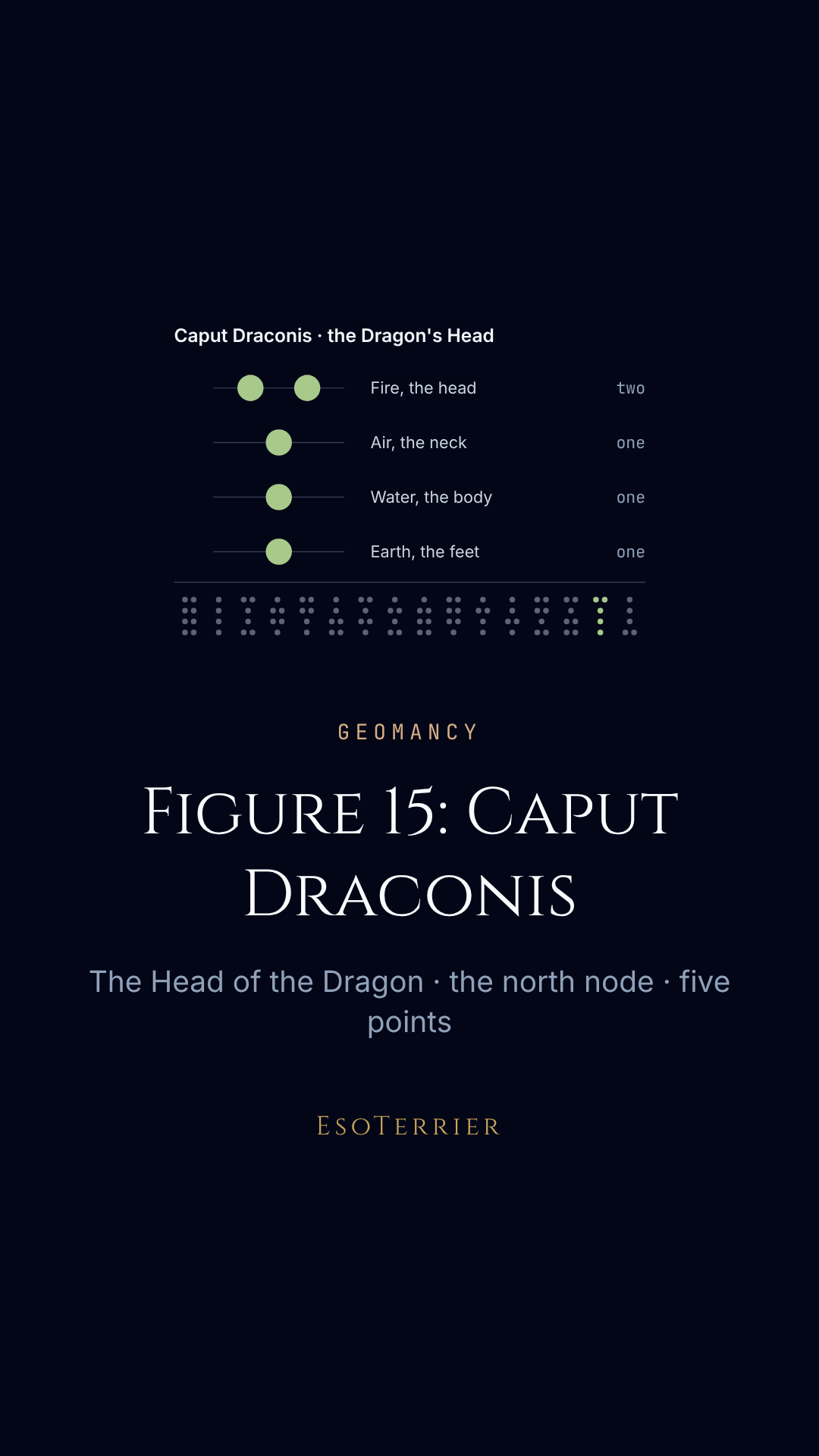
Caput Draconis has five points, so it can never be Judge, and with its double head the Way of the Point never runs through it. Upside down it becomes Cauda Draconis, its partner; with every point swapped it becomes Laetitia. In Gerard's scheme it is Virgo, and Agrippa's table, Cattan's own and Hartmann agree; Cattan's page 63 gives Gemini, and the Golden Dawn gives the Dragons no sign. Wikipedia gives the Head Sagittarius and calls that Gerard's, but Sagittarius is Gerard's sign for the Tail: the two are swapped there, and we never copy them.
Correspondences
Each item with how it stands: “sourced” is in the work cited, “our construction” is EsoTerrier’s own, and “disputed” means the sources disagree.
- Planet
- None: the Moon's north node, with the natures of Jupiter and Venus (Cattan 1591 p. 54; Crowley 1909 p. 142) (Cattan, p. 54; Crowley, p. 142) sourced
- Sign, Gerard's scheme (ours)
- Virgo sourced
- Sign, other schemes
- Agrippa (1651): Virgo; Cattan's table (p. 56): Virgo; Cattan's “Gerard Cremon” (p. 63): Gemini; the Golden Dawn (1909): no sign disputed
- Quality (Cattan's rule)
- Entering, and good (pp. 62, 215) sourced
- Lines
- Single, active: Air (neck), Water (body) and Earth (feet); double, passive: Fire (head) sourced
- Our keywords
- A beginning, a threshold, coming in our construction
How the schools read it
- Cattan (1591)
- Calls it “the dragons head”; entering, and good (pp. 62, 215).
- Agrippa (1651)
- Glosses it “The head”, “The threshold entring”, “The upper threshold”.
- *Of Geomancy* (1655)
- The Moon's north node; the 1655 text says the two Dragons 'follow their own natures'.
- Hartmann (1889)
- “Caput Draconis, Dragon's head, entrance, threshold, upper kingdom, is good.”
- The Golden Dawn (Crowley, 1909)
- “Good with good, evil with evil; gives a good issue for gain”
- Modern practice (Greer, as reported)
- Calls it stable, the modern word for an entering figure.
- EsoTerrier
- A beginning, a threshold, coming in (our one-line reading in the chart).
Claims about it
-
Caput Draconis is a figure a person is born under, worked out from a name and a birth date.
falseWhat the record shows: No source makes a geomantic figure from birth data; every casting is for a question. Our own app did this until October 2026, and the method was retired.
-
Caput Draconis has one zodiac sign.
disputedWhat the record shows: Gerard's scheme gives Virgo, the Golden Dawn no sign, Cattan's page 63 Gemini. At least six schemes exist; we always name the one we use.
-
Caput Draconis has an element of its own.
disputedWhat the record shows: The sources give the figures at least six different sets of elements. We show only the four line elements, never an element for the whole figure.
-
Gerard of Cremona gives Caput Draconis Sagittarius and Cauda Draconis Virgo.
falseWhat the record shows: The 1655 English of the Astronomical Geomancy gives the Head Virgo and the Tail Sagittarius, as Agrippa and Hartmann do. Wikipedia has the two swapped.