Meaning
Coniunctio is a joining: people meeting, things coming together, a lost thing finding its way back. It has no fortune of its own. Cattan counts it among his "meane" figures, good with good figures and ill with ill; Hartmann calls it "rather good than bad"; the Hermetic Order of the Golden Dawn's handbook says "good with good, and evil with evil", and adds the recovery of things lost. The 1655 Of Geomancy counts both of Mercury's figures as good, and Coniunctio as the more fortunate. Read it with its neighbours, since it brings together whatever they stand for. In our own words, it favours agreements and reconciliations, and goes against the asker only where a meeting is the last thing wanted.
In the shield
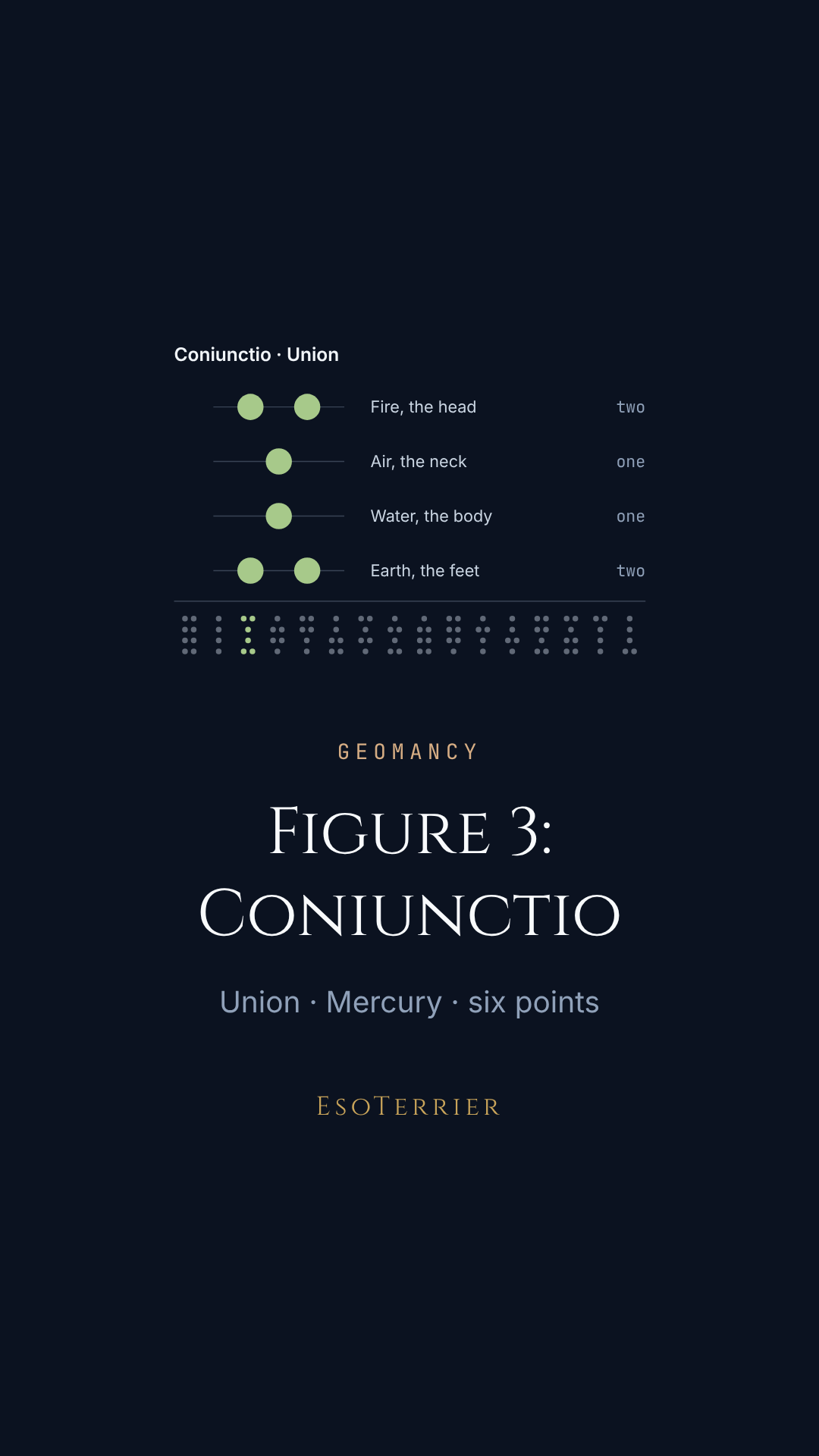
With six points, Coniunctio is even and can be Judge, for one casting in eight. Its shape is the same upside down, and with every point swapped it becomes Carcer, the Prison: a crossing set against an enclosure. Its partner under Mercury is Albus. Its head line is double, so when Coniunctio is the Judge there is no Way of the Point under the single-point rule we use, though Cattan's older rule would still follow its double point.
Names and signs
Cattan's English of 1591 calls it "coniunction", and Agrippa's of 1651 glosses it "Conjunction" and "An Assembling". We keep the Latin spelling Coniunctio, as our chart does; most modern books write Conjunctio. Its sign is one of the few the sources agree on: Virgo, in Gerard's scheme, in Agrippa, in Cattan's own table and under Gerard's name on his page 63, and in the Golden Dawn's. Cattan's table of the planets makes it Mercury retrograde, and Albus Mercury direct.
Correspondences
Each item with how it stands: “sourced” is in the work cited, “our construction” is EsoTerrier’s own, and “disputed” means the sources disagree.
- Planet
- Mercury, in every source checked (Cattan, Agrippa, the 1655 text, Hartmann, Crowley, Fludd) sourced
- Direct or retrograde (Cattan, p. 54)
- Mercury retrograde sourced
- Sign, Gerard's scheme (ours)
- Virgo sourced
- Sign, other schemes
- Virgo in all of them: Agrippa (1651), Cattan's table (p. 56), his “Gerard Cremon” (p. 63) and the Golden Dawn (1909) sourced
- Quality (Cattan's rule)
- “meane”: neither good nor bad, taking its quality from its company (pp. 62, 215) sourced
- Lines
- Single, active: Air (neck) and Water (body); double, passive: Fire (head) and Earth (feet) sourced
- Our keywords
- Meeting, joining, crossroads our construction
How the schools read it
- Cattan (1591)
- Calls it “coniunction”; “meane”: neither good nor bad, taking its quality from its company (pp. 62, 215).
- Agrippa (1651)
- Glosses it “Conjunction”, “An Assembling”.
- *Of Geomancy* (1655)
- Mercury, the more fortunate of his two figures (Coniunctio and Albus are both good, Coniunctio the more fortunate).
- Hartmann (1889)
- “Conjunctio, union or coming together, is rather good than bad.”
- The Golden Dawn (Crowley, 1909)
- “Good with good, and evil with evil. Recovery of things lost”
- Modern practice (Greer, as reported)
- Calls it mobile, giving a direction even to a figure the old rule calls “meane”.
- EsoTerrier
- Meeting, joining, crossroads (our one-line reading in the chart).
Claims about it
-
Coniunctio is a figure a person is born under, worked out from a name and a birth date.
falseWhat the record shows: No source makes a geomantic figure from birth data; every casting is for a question. Our own app did this until October 2026, and the method was retired.
-
Coniunctio has one zodiac sign.
disputedWhat the record shows: Every scheme we read gives it Virgo, a rare agreement; elsewhere at least six schemes disagree, so we still say whose sign we show.
-
Coniunctio has an element of its own.
disputedWhat the record shows: The sources give the figures at least six different sets of elements. We show only the four line elements, never an element for the whole figure.