Meaning
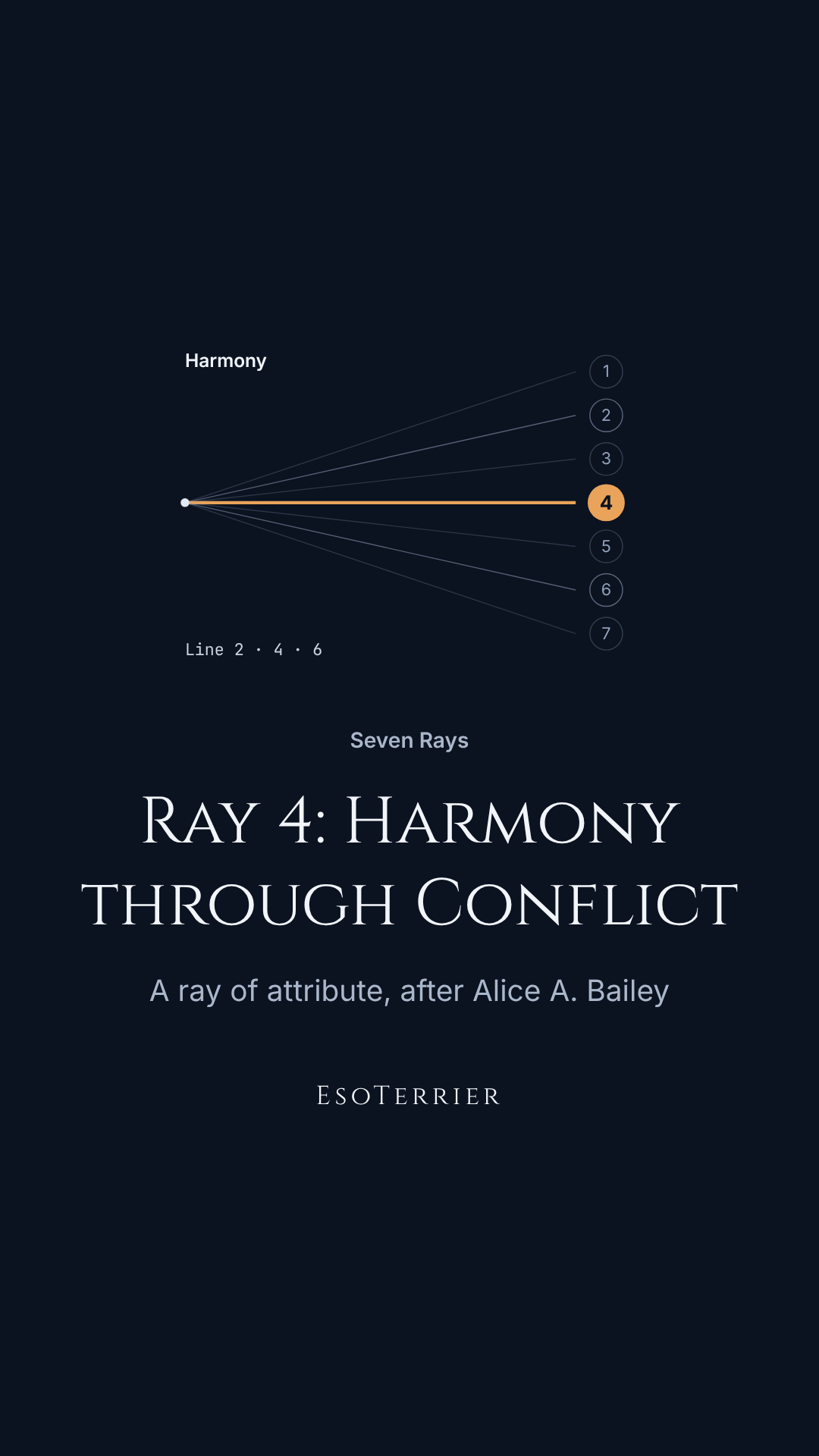
The fourth ray stands at the middle of Bailey's seven and opens her four rays of attribute. In her teaching it is the energy that reaches harmony through conflict: it holds opposites together until they resolve, lives between high and low, and makes beauty out of the tension. She calls it the ray of colour and of the artist, and also names it Harmony, Beauty and Art; in her scheme it is the ray of humanity itself. It lies on the even line with the second and sixth rays.
Under her rule for the bodies it is one of three rays that may govern the mind, with the first and fifth. The soul and the personality may be on it; the monad, in her scheme, never is, since a monad is always on one of the first three rays.
In our own words, it is the ray of beauty won from struggle: the person who feels both sides of everything and can make something whole of them, and whose risk is a life of swinging moods and hard choices put off. No chart decides whether anyone is on this ray.
Her keynote for the ray is Harmonisation, and Intuition is the keynote she gives it for humanity now; the aspect of the will is the will to harmonise or relate. Its word of power is on page 518 of The Rays and the Initiations, cited and not quoted.
Bailey's three lists
In our paraphrase of Esoteric Psychology I (pp. 205 to 206):
- Special virtues: strong affections, sympathy, physical courage, generosity, devotion, and quickness of intellect and perception.
- Vices: self-centredness, worrying, inaccuracy, lack of moral courage, strong passions, indolence and extravagance.
- Virtues to be acquired: serenity, confidence, self-control, purity, unselfishness, accuracy, and mental and moral balance.
The pairing is striking: physical courage among the virtues and lack of moral courage among the vices. Lists elsewhere add combativeness and moodiness; neither is in her table.
In a birth chart
Bailey's table sends the fourth ray through Taurus, Scorpio and Sagittarius. Her sacred fourth-ray planet is Mercury; her non-sacred one is the Moon, which she says veils a hidden planet, leaving the astrologer to judge which. Through its rulers the ray reaches Gemini and Virgo in her orthodox set, Aries in her esoteric set and Scorpio in her hierarchical set through Mercury, and Cancer, Virgo and Aquarius through the Moon.
A Sun in Taurus, or a Moon placed high in a chart, indicates fourth-ray energy acting on a person, by her tables; it does not say what anyone's rays are.
A note on the source: scholars have criticised racist and antisemitic passages in Bailey's writings; nothing on this page draws on them.
Correspondences
Each item with how it stands: “sourced” is in the work cited, “our construction” is EsoTerrier’s own, and “disputed” means the sources disagree.
- Other names Bailey uses
- Harmony, Beauty and Art sourced
- Rulerships in Bailey's three sets
- Mercury rules Gemini and Virgo (orthodox), Aries (esoteric) and Scorpio (hierarchical); the Moon rules Cancer (orthodox), Virgo (esoteric) and Aquarius (hierarchical) sourced
- Bailey's colour
- Yellow, a name she says is meant to blind (Letters on Occult Meditation, pp. 213 to 214) sourced
- Other colour lists
- Other lists differ, and none is the tradition's disputed
- Colour in our chart
- An ochre of our own, shown only beside the numeral our construction
- Wood's type (1925)
- The man of imagination: the magician, the actor, the symbolic artist or poet sourced
- Leadbeater's table (1925)
- The birth of Horus as its characteristic; hatha yoga as its magic; the Egyptian as its last religion sourced
- Head of the ray
- Bailey taught (1922) that the Master Serapis and a Master she calls P. are on the fourth ray, under the Mahachohan. sourced
How the schools read it
- Bailey (1936 to 1951)
- Harmony reached through conflict: the ray of colour, of the artist, and of humanity as a whole.
- Wood (1925)
- The man of imagination, in three forms: magician, actor, symbolic artist or poet.
- Leadbeater (1925)
- Hatha yoga and Egypt, in the table he said a Master gave him and called partial.
- Ascended Master teachings
- A separate later stream with its own colour and head for the fourth ray; not Bailey's, and not what we show.
- EsoTerrier
- Read here as the ray of beauty won from struggle, whose risk is swinging moods and postponing hard choices.
Claims about it
-
A line about two roads meeting is the fourth ray's keynote.
falseWhat the record shows: No source was found for it. Bailey's keynote for the fourth ray is the single word Harmonisation.
-
Bailey lists combativeness and moodiness among the fourth ray's vices.
falseWhat the record shows: Neither word is in her table (Esoteric Psychology I, pp. 205 to 206). Our old engine added them.
-
Bailey fixes the Moon as veiling Vulcan.
disputedWhat the record shows: She names the veiled planets and leaves the choice to the astrologer. Our chart shows the Moon with a note and substitutes nothing.
-
Yellow is the fourth ray's colour in the tradition.
disputedWhat the record shows: Bailey gives yellow as an outer name meant to blind; the other lists differ.