Meaning
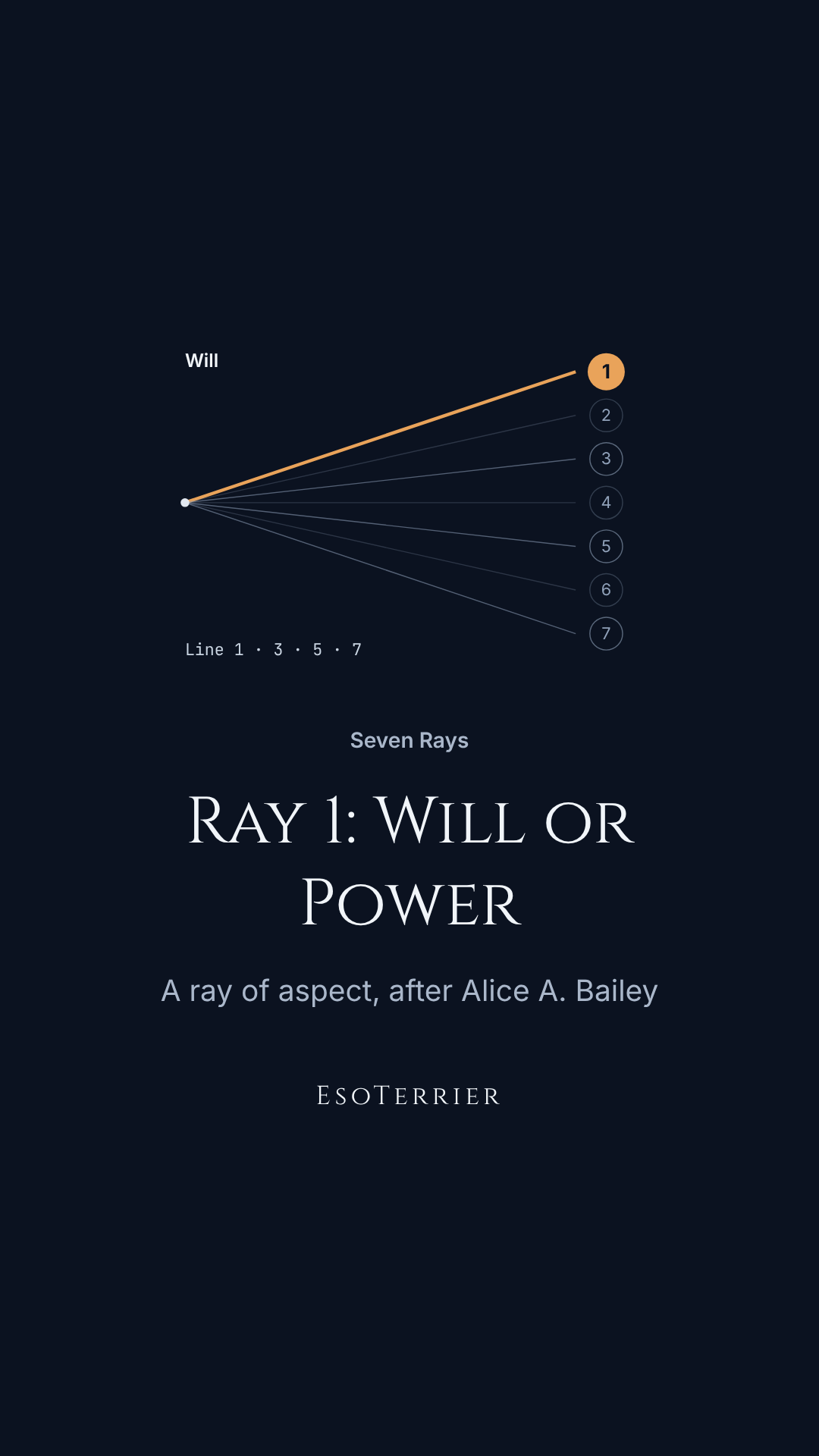
In Bailey's teaching the first ray is the energy of will. It decides, begins and ends things, and once a direction is chosen it holds to it. She puts it first among the three rays of aspect, the deepest of her seven, and on the line of the odd rays that runs 1, 3, 5, 7. Under her rule for the bodies it is one of three rays that may govern the mind, alongside the fourth and fifth; it does not normally govern the emotions or the physical body. The soul and the personality may be on it, as on any ray, and so may the monad, whose ray in her scheme is always the first, second or third.
Read in our own words, it is the ray of purpose and leadership: the person who sees what has to be done and carries it through, and whose risk is impatience with everyone who moves more slowly. A person's own rays are what they confirm for themselves; a chart only indicates where this energy acts.
Bailey's one-word keynote for the ray is Initiation, and she gives the same word as its keynote for humanity now; the aspect of the will she pairs with it is the will to initiate. Its word of power, a sentence for a particular stage of inner work, is on page 515 of The Rays and the Initiations; that book is still in copyright in the United States, so we cite the page and do not quote it.
Bailey's three lists
Bailey gives each ray three short lists in Esoteric Psychology I, in a summary she calls "necessarily imperfect". In our paraphrase, for the first ray (p. 201):
- Special virtues: strength, courage, steadiness, a truthfulness that comes from having no fear, the ability to rule, and the capacity to take large questions in a large way and to handle people and affairs.
- Vices: pride, ambition, wilfulness, hardness, arrogance, the wish to control others, obstinacy and anger.
- Virtues to be acquired: tenderness, humility, sympathy, tolerance and patience.
The third list is the telling one: the qualities she says the first ray has to learn are the soft ones. Older Theosophy argued over whether a ray fixes any such qualities at all; Subba Row said it does not.
In a birth chart
Bailey's table of the signs sends the first ray through Aries, Leo and Capricorn, which she says pass it on to the earth via the Sun for the present turn of the zodiac. Her sacred first-ray planet is Vulcan, a hypothetical planet inside Mercury's orbit that no ephemeris places, so our chart names it as a ruler and gives it no position; her non-sacred first-ray planet is Pluto, which her text names in place of Mars as the ruler of Scorpio, although her table keeps Mars. Bailey also notes that her orthodox rulers carry every ray except the first.
So when a chart shows a Sun in Leo, or Pluto prominent, it indicates first-ray energy acting on the person, by Bailey's tables. It does not make anyone a first-ray person.
A note on the source: scholars have criticised racist and antisemitic passages in Bailey's writings; nothing on this page draws on them.
Correspondences
Each item with how it stands: “sourced” is in the work cited, “our construction” is EsoTerrier’s own, and “disputed” means the sources disagree.
- Other names Bailey uses
- Power or Will sourced
- Rulerships in Bailey's three sets
- Vulcan rules Taurus (esoteric and hierarchical); Pluto rules Pisces (esoteric and hierarchical) and, by her own text, Scorpio, beside the Mars of her table sourced
- Bailey's colour
- Withheld: she says she does not yet assign it (Letters on Occult Meditation, p. 213) sourced
- Other colour lists
- Other lists differ, and none is the tradition's disputed
- Colour in our chart
- A red of our own, shown only beside the numeral to tell the rays apart our construction
- Planet in an older Theosophical list
- Older lists, which Bailey reprints without endorsing, give other planets disputed
- Wood's type (1925)
- The ruler sourced
- Leadbeater's table (1925)
- Power as its leading characteristic; its magic and religion left blank sourced
- Head of the ray
- Bailey taught (1922) that the Manu heads the first ray and that the Master Morya is on it. sourced
How the schools read it
- Bailey (1936 to 1951)
- The energy of will and purpose: it decides, begins and ends things and holds a direction once chosen.
- Subba Row (1880s)
- A ray names a class, not a character: belonging to it says nothing about moral or mental qualities.
- Wood (1925)
- The ruler: the type who seeks freedom by mastering himself and his surroundings.
- Leadbeater (1925)
- Power is the ray's most prominent characteristic.
- Ascended Master teachings
- A separate later stream with its own colour, head and chakra for the first ray; not Bailey's, and not what we show.
- EsoTerrier
- Read here as the ray of purpose and leadership, whose risk is impatience with everyone else.
Claims about it
-
The planets of ray 1 are Pluto (higher) and Mars (lower).
falseWhat the record shows: Bailey gives Vulcan as the sacred first-ray planet and Pluto as the non-sacred one; Mars carries the sixth ray.
-
A Sun in Aries, Leo or Capricorn makes a person a first-ray type.
falseWhat the record shows: Bailey says the signs transmit rays to the planet via the Sun and that the astrologer must know the rays before reading the chart.
-
The first ray's signs are Taurus and Pisces.
disputedWhat the record shows: Those are signs ruled by its planets. Bailey's own table of the signs through which the ray is transmitted gives Aries, Leo and Capricorn.
-
The ray's word of power is its motto for the personality.
unverifiedWhat the record shows: In Bailey's book it is a sentence for a stage of inner work. We cite its page (p. 515) and do not quote it.
-
Red is the first ray's colour in the tradition.
disputedWhat the record shows: Bailey withheld the first ray's colour; the colour lists in circulation are later conventions.