Meaning
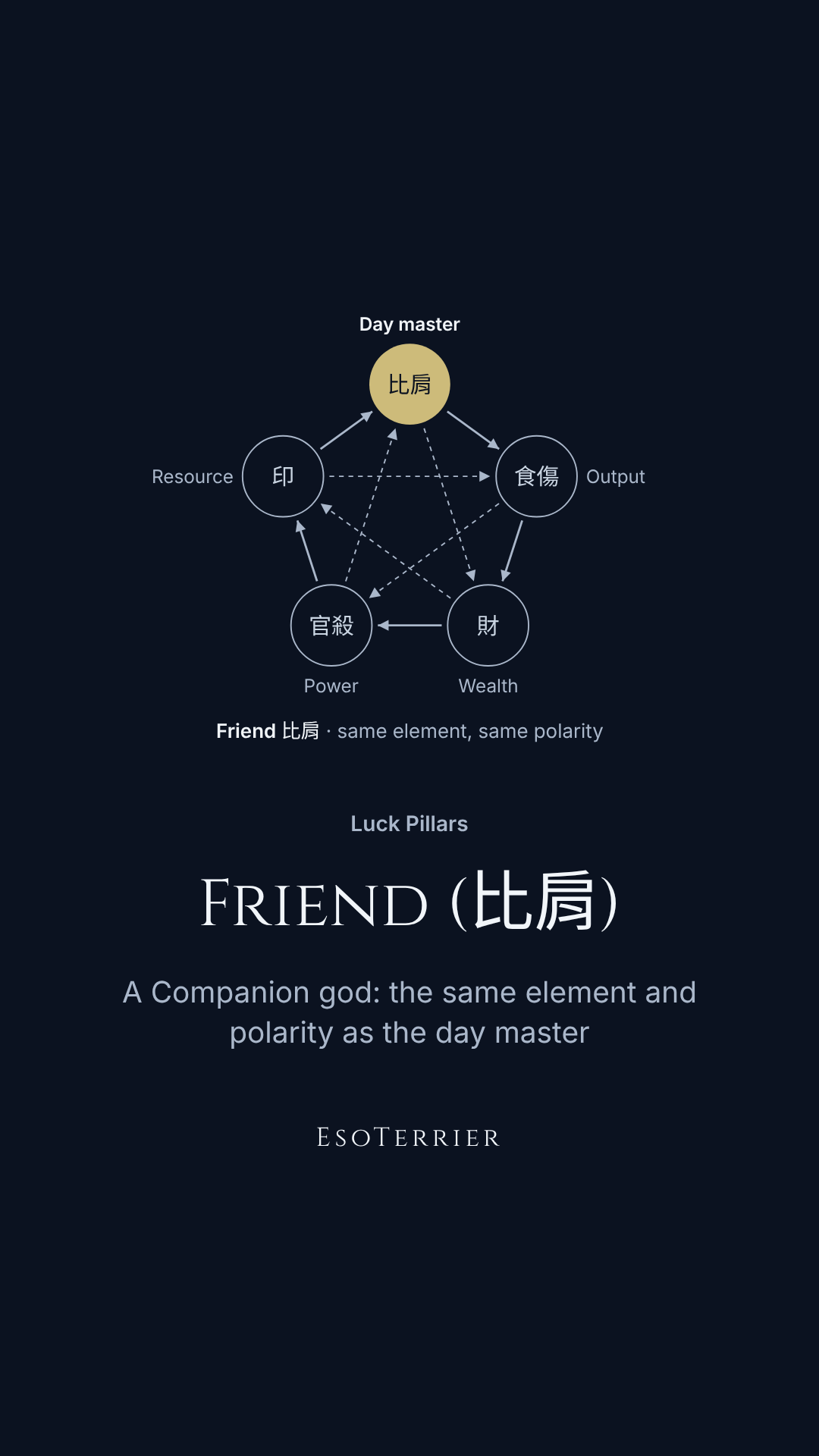
比肩 means "shoulder to shoulder". It is the stem that matches the day master in both element and polarity: for a 甲 day master another 甲, for a 乙 another 乙, for a 庚 another 庚. In the grammar of the chart it is the day master's double, a second self standing beside the first.
The classical texts say surprisingly little about it on its own. The 淵海子平's opening table puts it with brothers, and for a yin day master with brothers and friends, and its Ten God essays treat it mostly through its partner, Rob Wealth. The 三命通會 explains the whole family of companions through what they do to wealth: the stems the day master controls are its wealth, a peer of the same element controls them too, and so 「財怕劫」, wealth fears the robber. That thin classical record is why English teaching reads the Friend from its structure, as peers, independence and competition, and why our chart's own one-line nature for it is "peers, independence, competition, standing on your own". That line is ours, a modern reading, and the pages label it so.
One point the old texts and our earlier engine got differently. The day stem is never a Ten God of itself: it is the point every Ten God is counted from, and every tool surveyed labels it 日主, the Day Master. Our engine called the day stem 比肩 until October 2026; it was corrected. A Friend in a chart is always another stem, in another pillar, a hidden stem, a luck pillar or a year.
Our earlier pages called this god "Companion". "Friend" is the name most English sources and calculators use, so we changed it, and the old Companion address now leads to this page. "Companions" stays the name of the family, 比劫, which holds the Friend and Rob Wealth.
In a luck pillar
A Friend pillar is one whose stem is the day master's own element and polarity. The tradition reads such a decade as one that strengthens the day master and brings peers, sharing and competition to the front. How it weighs that depends on the chart: a weak day master is said to welcome the support, a strong one to find it crowding. That is a judgment of strength, and EsoTerrier does not make it.
The texts give the rule in their own terms. The 淵海子平 lists luck in the 寅 and 卯 branches for a 甲 or 乙 day master among the companions, and the 三命通會 says that wealth wants a luck that supports it, not one that robs it (「財欲運扶,不欲運劫」). Both books add that a luck pillar is weighed mostly by its branch, and the 淵海子平 calls its own list of decades a fixed rule given only as illustration, to be weighed against the whole chart. So the Ten God of the stem names the decade; it does not decide it.
On our chart a Friend pillar is shown as what it is: the stem, its Ten God, the hidden stems of the branch with theirs, and the relations the pillar forms with the natal pillars. We do not say what such a decade brings.
The Friend for each day master
The Friend is always the day master's own stem, so the table is the cycle of ten stems read against itself.
| Day master | Friend |
|---|---|
| 甲 Jiǎ (yang wood) | 甲 Jiǎ |
| 乙 Yǐ (yin wood) | 乙 Yǐ |
| 丙 Bǐng (yang fire) | 丙 Bǐng |
| 丁 Dīng (yin fire) | 丁 Dīng |
| 戊 Wù (yang earth) | 戊 Wù |
| 己 Jǐ (yin earth) | 己 Jǐ |
| 庚 Gēng (yang metal) | 庚 Gēng |
| 辛 Xīn (yin metal) | 辛 Xīn |
| 壬 Rén (yang water) | 壬 Rén |
| 癸 Guǐ (yin water) | 癸 Guǐ |
In the classical texts
The 淵海子平's family table makes 比肩 the brothers and sisters, in men's and women's charts alike, and 任鐵樵, writing in the Qing, keeps the same reading: 「同我者為兄弟」. Like every line of that table it is a reading of its age, recorded here as history; no page or reading of ours applies it to anyone's family.
The 窮通寶鑑, a Qing manual arranged by element and season, is one of the few texts that names 比肩 outright in its advice: summer earth "is blocked when it sees 比肩", autumn earth "gains help from" it, and summer water "wants" it. The book judges by season, not by a fixed meaning of the god.
The 神 in 十神 is a technical word for a relation between stems. None of the Ten Gods is a deity, and nothing in the system is worshipped.
Correspondences
Each item with how it stands: “sourced” is in the work cited, “our construction” is EsoTerrier’s own, and “disputed” means the sources disagree.
- Classical role, 甲 day master
- Brothers (兄弟), in the 淵海子平's opening table sourced
- Classical role, 乙 day master
- Brothers and friends (兄弟、朋友), in the same table sourced
- Family role in the 六親 table
- Brothers and sisters, in men's and women's charts alike; 任鐵樵 agrees. A gendered table of its age, recorded as history disputed
- In the element essays
- The 窮通寶鑑 uses the word directly: summer earth is blocked by 比肩, autumn earth is helped by it sourced
- Other English names
- Companion (our own earlier name), Parallel, Shoulder-to-Shoulder, Friends sourced
- Modern English teaching
- Peers, siblings and friends sourced
- Our one-line nature
- Peers, independence, competition, standing on your own our construction
How the schools read it
- *淵海子平* (Song material, Ming printing)
- Lists it with brothers, and for a yin day master with friends; says little else about it directly.
- *三命通會* (Ming)
- Explains the whole family through wealth: 「財怕劫」, wealth fears the robber, because peers share what the day master controls.
- 任鐵樵 on the *滴天髓* (Qing)
- Keeps the companions as brothers: 「同我者為兄弟」, what is the same as me is my brothers.
- Modern English teaching
- Peers, independence and competition; the family name Companions for the pair.
- EsoTerrier
- Our chart's line, a modern reading of our own: peers, independence, competition, standing on your own.
Claims about it
-
The day stem is itself a 比肩, and a chart should label it so.
falseWhat the record shows: The Ten Gods describe other stems against the day master; every tool surveyed labels the day stem 日主, Day Master. Our engine did otherwise until October 2026 and was corrected.
-
"Companion" is the standard English name of 比肩.
disputedWhat the record shows: Friend is the name most English sources and apps use. Our earlier pages said Companion; that address now leads here, and Companions stays the name of the family.
-
The Friend stands for a person's brothers and sisters.
disputedWhat the record shows: That is the 淵海子平's family table, of its time. It is recorded here as history and never applied to anyone's family.
-
Each Ten God is one of ten personality types.
unverifiedWhat the record shows: A modern branded set from English teaching, not the tradition. The single word Friend for 比肩 is older than that set and used outside it.