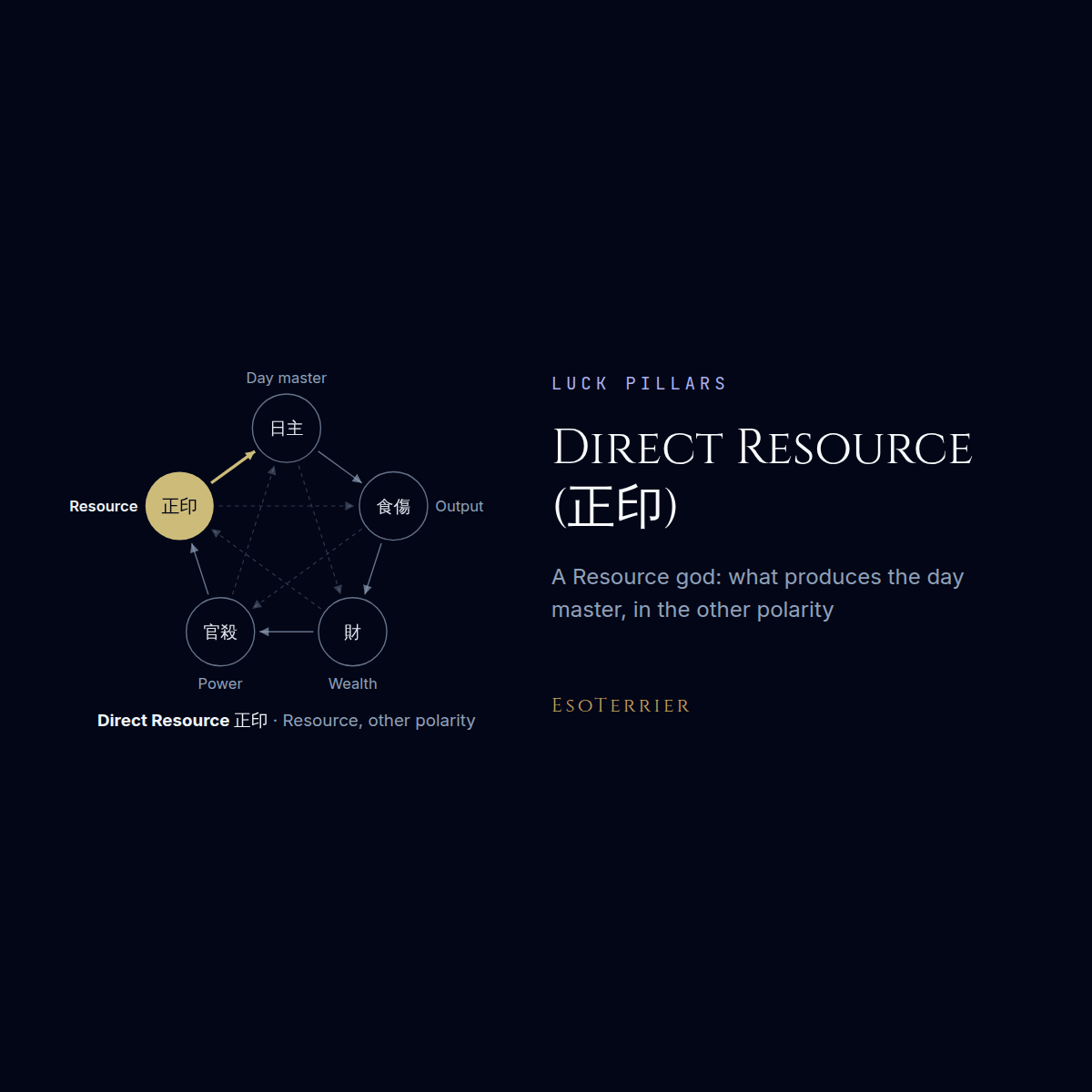
Meaning
正印 is the stem that produces the day master in the other polarity. Water produces wood, so for a 甲 day master Direct Resource is 癸, yin water; for a 乙 day master 壬; for a 丁 day master, produced by wood, 甲.
Its classical name is 印綬: the seal of office and the silk ribbon it hangs from. The 三命通會 reads both characters. 印 is shelter, 綬 is receiving: the favour a child receives from its parents, and the seal without which an office has no authority. The 淵海子平 quotes a saying that makes the same link from the other end: an officer without a seal is no true officer, while a seal without an officer still brings good. In its essay the god is simply what helps, produces and nourishes the self.
The same book notes that the seal fears wealth. The chain is structural: the day master controls its wealth, wealth controls the seal, so a chart heavy with wealth presses on its own source of support. The 淵海子平's essay does not separate the direct seal from the indirect there; the indirect form has its own entry as 倒食.
Modern English teaching reads education, support and, in older readings, the mother; our chart's one-line nature, labelled as ours, is "support, education, nurture, recognition". One name to keep apart: the 三命通會's third juan also lists a 正印 among the stars of the Na Yin elements, keyed to each element's storage branch. Same characters, a different thing; it is not this god.
In a luck pillar
A Direct Resource pillar has a stem that produces the day master in the other polarity. The tradition reads it as a decade of support, learning and shelter. The 淵海子平 lists luck in 壬, 癸, 亥 and 子 for a 甲 or 乙 day master as the life-giving seal luck, and the 三命通會 says the seal wants a luck that strengthens it and not one that weakens it (「印欲運旺,不欲運衰」). The texts' promises of blessing and property are not reproduced.
Our earlier page called decades of this family a winter to wait out. The texts say no such thing: they weigh the pillar against the whole chart, the day master's strength and the useful god, which EsoTerrier does not compute. Our chart names the pillar, gives its branch, hidden stems and relations with the natal pillars, and leaves the decade unjudged.
Direct Resource for each day master
The producing element, in the other polarity.
| Day master | Direct Resource |
|---|---|
| 甲 Jiǎ (yang wood) | 癸 Guǐ |
| 乙 Yǐ (yin wood) | 壬 Rén |
| 丙 Bǐng (yang fire) | 乙 Yǐ |
| 丁 Dīng (yin fire) | 甲 Jiǎ |
| 戊 Wù (yang earth) | 丁 Dīng |
| 己 Jǐ (yin earth) | 丙 Bǐng |
| 庚 Gēng (yang metal) | 己 Jǐ |
| 辛 Xīn (yin metal) | 戊 Wù |
| 壬 Rén (yang water) | 辛 Xīn |
| 癸 Guǐ (yin water) | 庚 Gēng |
In the classical texts
The 滴天髓's verse on 丁 says that "with a proper mother" (「如有嫡母」) it does well in autumn and winter. 甲 is 丁's Direct Resource, and the older commentary makes the point by contrast: 乙, the Indirect Resource, "is not 丁's proper mother".
The 淵海子平's table names the god 印綬, 正人 and 君子, the upright person and the gentleman; its family table makes it the mother (正印正母). 任鐵樵 read both Resource gods as the parents. These are readings of their age, labelled disputed and never applied to anyone's family.
Correspondences
Each item with how it stands: “sourced” is in the work cited, “our construction” is EsoTerrier’s own, and “disputed” means the sources disagree.
- The classical name
- 印綬, the seal and its ribbon; 印 read as shelter and 綬 as receiving in the 三命通會 sourced
- Other names in the table
- 正人 and 君子, the upright person and the gentleman, in the 淵海子平 sourced
- What it fears
- Wealth, which controls it: the 淵海子平 notes that the seal fears wealth sourced
- Family role in the 六親 table
- The mother (正印正母); 任鐵樵 reads both Resource gods as the parents. Recorded as history disputed
- In the stem verses
- The 滴天髓 on 丁: with a proper mother it does well in autumn and winter (「如有嫡母」); 甲 is 丁's Direct Resource sourced
- A different 正印
- The 三命通會's juan 3 has a 納音 star of the same name, keyed to the element's storage branch; it is not this god sourced
- Our one-line nature
- Support, education, nurture, recognition our construction
How the schools read it
- *淵海子平* (Song material, Ming printing)
- What helps, produces and nourishes the self; an officer without a seal is no true officer, while a seal without an officer still does good.
- *三命通會* (Ming)
- Reads 印 as shelter and 綬 as receiving: the parents' favour, and the seal without which an office has no authority.
- 任鐵樵 on the *滴天髓* (Qing)
- Both Resource gods are the parents: 「生我者為父母」.
- Modern English teaching
- Education, support and, in older readings, the mother.
- EsoTerrier
- Our chart's line, a modern reading of our own: support, education, nurture, recognition.
Claims about it
-
Direct Resource shares the day master's polarity.
falseWhat the record shows: The classical rule puts the direct gods on the opposite polarity. English Wikipedia's table has this pair reversed; our tables follow the texts.
-
Direct Resource is the mother.
disputedWhat the record shows: The 淵海子平's family table says so, and modern teaching repeats it; 任鐵樵 read both Resource gods as the parents. History, never applied to a person.
-
A Resource decade is a quiet time to wait things out.
unverifiedWhat the record shows: A seasonal label from modern teaching, not the texts, which weigh the pillar against the chart.