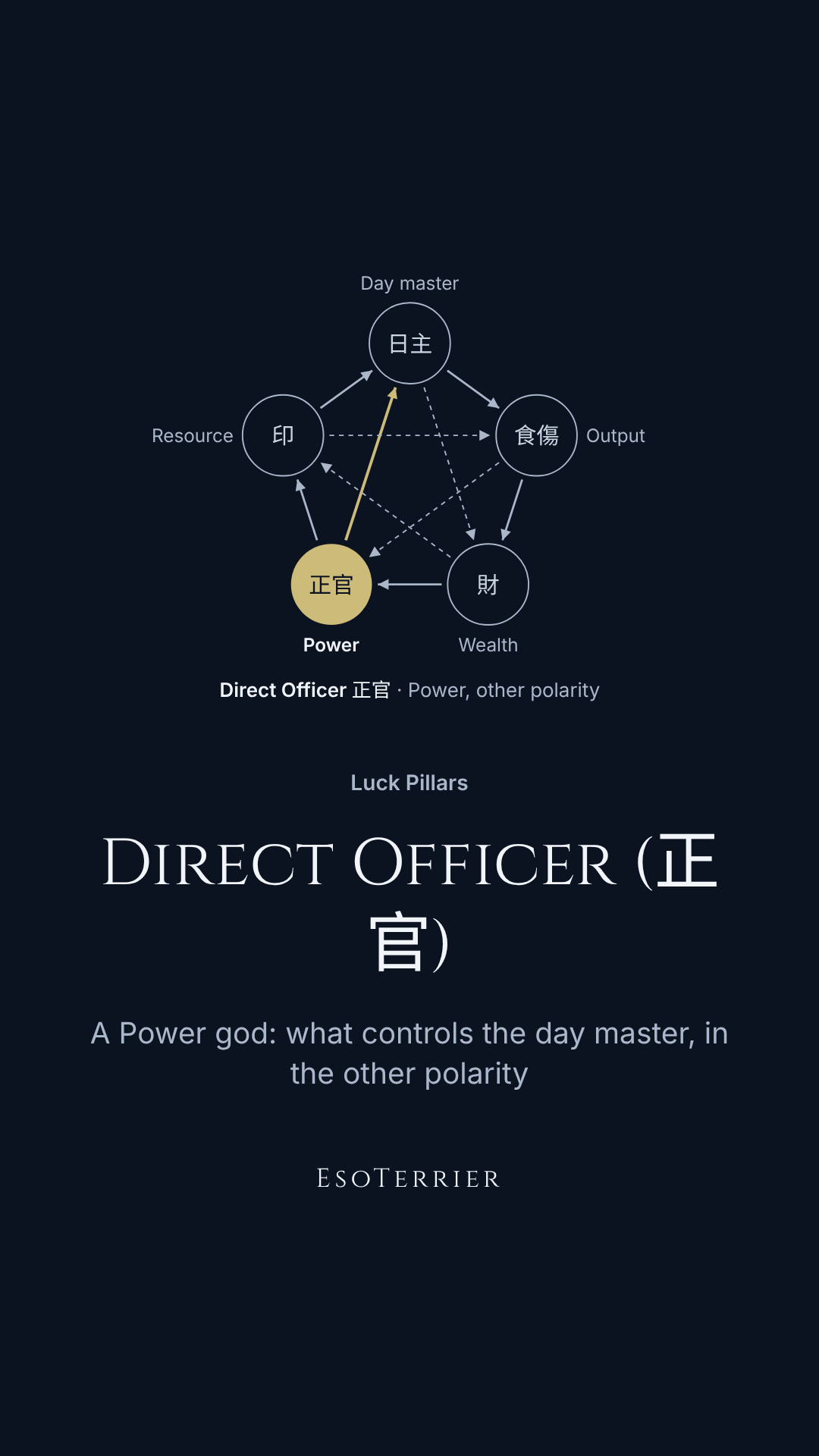
Meaning
正官 is the stem that controls the day master in the other polarity. Metal controls wood, so for a 甲 day master the Direct Officer is 辛, yin metal; for a 乙 day master 庚; for a 丁 day master, controlled by water, 壬.
The 三命通會 explains both the name and the rule. An office is given by the court, it says, and with it the holder belongs to the public, bound to serve until the coffin closes: control, but control that comes with a place. And it gives the polarity in one line, 「甲見辛為正官,見庚為偏官」: yin matched with yang is the proper pairing, so the controller of the other polarity is the "direct" officer. English Wikipedia's table has this pair reversed; our tables follow the texts.
The book makes the Direct Officer the first of its six patterns, wants only one of it in a chart, and reads it first from the month branch. The 淵海子平's table gives it salary and horse (祿馬) and the god of honour (榮神), and repeats the saying that an officer without a seal is no true officer.
Modern English teaching reads discipline and status, and, in older readings, a woman's husband; our chart's one-line nature, labelled as ours, is "duty, status, discipline, authority given": the control of a recognised order, as against the pressure of Seven Killings.
In a luck pillar
A Direct Officer pillar has a stem that controls the day master in the other polarity. The tradition reads it as a decade of duty and standing. The 三命通會's rule is that the officer wants a luck that produces it and not one that hurts it (「官欲運生,不欲運傷」), and that a chart that already has an officer develops it in an officer luck (「原有官,行官運發官」). Both are the texts' idiom, quoted as such.
The tradition reads all of this with the natal chart first: whether there is an officer, whether a Hurting Officer stands against it, whether a seal supports it, and how strong the day master is. EsoTerrier does not judge strength or the useful god, so our chart names the pillar and shows its branch, hidden stems and relations with the natal pillars, and makes no promise about work or standing.
The Direct Officer for each day master
The controlling element, in the other polarity.
| Day master | Direct Officer |
|---|---|
| 甲 Jiǎ (yang wood) | 辛 Xīn |
| 乙 Yǐ (yin wood) | 庚 Gēng |
| 丙 Bǐng (yang fire) | 癸 Guǐ |
| 丁 Dīng (yin fire) | 壬 Rén |
| 戊 Wù (yang earth) | 乙 Yǐ |
| 己 Jǐ (yin earth) | 甲 Jiǎ |
| 庚 Gēng (yang metal) | 丁 Dīng |
| 辛 Xīn (yin metal) | 丙 Bǐng |
| 壬 Rén (yang water) | 己 Jǐ |
| 癸 Guǐ (yin water) | 戊 Wù |
In the classical texts
The 滴天髓's verse on 丁 says that "combining with 壬 it is loyal" (「合壬而忠」): 壬 is 丁's Direct Officer, and the commentary calls it 丁's ruler. For a yin day master the Direct Officer is also its partner in combination, as Direct Wealth is for a yang one.
The 淵海子平's family table makes the Direct Officer a man's daughter and a woman's husband (「取官星為夫星」). 任鐵樵 rejected the officer gods as children and made what controls the day master the grandfather. These are readings of their age, recorded as history, labelled disputed, and never applied to anyone.
Correspondences
Each item with how it stands: “sourced” is in the work cited, “our construction” is EsoTerrier’s own, and “disputed” means the sources disagree.
- The polarity rule
- 「甲見辛為正官,見庚為偏官」: 甲 sees 辛 as the direct officer and 庚 as the indirect, in the 三命通會 sourced
- Other classical names
- 祿馬, salary and horse, and 榮神, the god of honour, in the 淵海子平's table; 官星, the officer star, in the texts' short form sourced
- Place among the patterns
- The first of the 三命通會's six patterns, read from the month branch first; one is wanted, not several sourced
- Family role in the 六親 table
- For a man the daughter, for a woman the husband; 任鐵樵 rejected the officer gods as children. Recorded as history disputed
- In the stem verses
- The 滴天髓 on 丁: combining with 壬 it is loyal (「合壬而忠」); 壬 is 丁's Direct Officer sourced
- Other English names
- Proper Officer, Legitimate Officer sourced
- Our one-line nature
- Duty, status, discipline, authority given our construction
How the schools read it
- *三命通會* (Ming)
- The court gives a post and with it the holder belongs to the public, bound to serve until the coffin closes; the first of six patterns.
- *淵海子平* (Song material, Ming printing)
- Salary and horse, the god of honour; an officer without a seal is not a true officer.
- *滴天髓* (verse of disputed date)
- 丁 combining with 壬, its Direct Officer, is loyal: the commentary calls 壬 丁's ruler.
- Modern English teaching
- Discipline and status for everyone; in older readings, the husband in a woman's chart.
- EsoTerrier
- Our chart's line, a modern reading of our own: duty, status, discipline, authority given.
Claims about it
-
The Direct Officer shares the day master's polarity.
falseWhat the record shows: The 三命通會 says the reverse in so many words: 甲 sees 辛 as the direct officer. English Wikipedia's table has this pair reversed.
-
The Direct Officer is a woman's husband.
disputedWhat the record shows: The 淵海子平's family table says so; modern teaching repeats it. It is the tradition's reading of its time, never applied to a person here.
-
An Officer decade is the time for promotion.
falseWhat the record shows: A modern reading of status onto a relation between stems. The texts weigh the pillar against the whole chart, and we make no such promise.