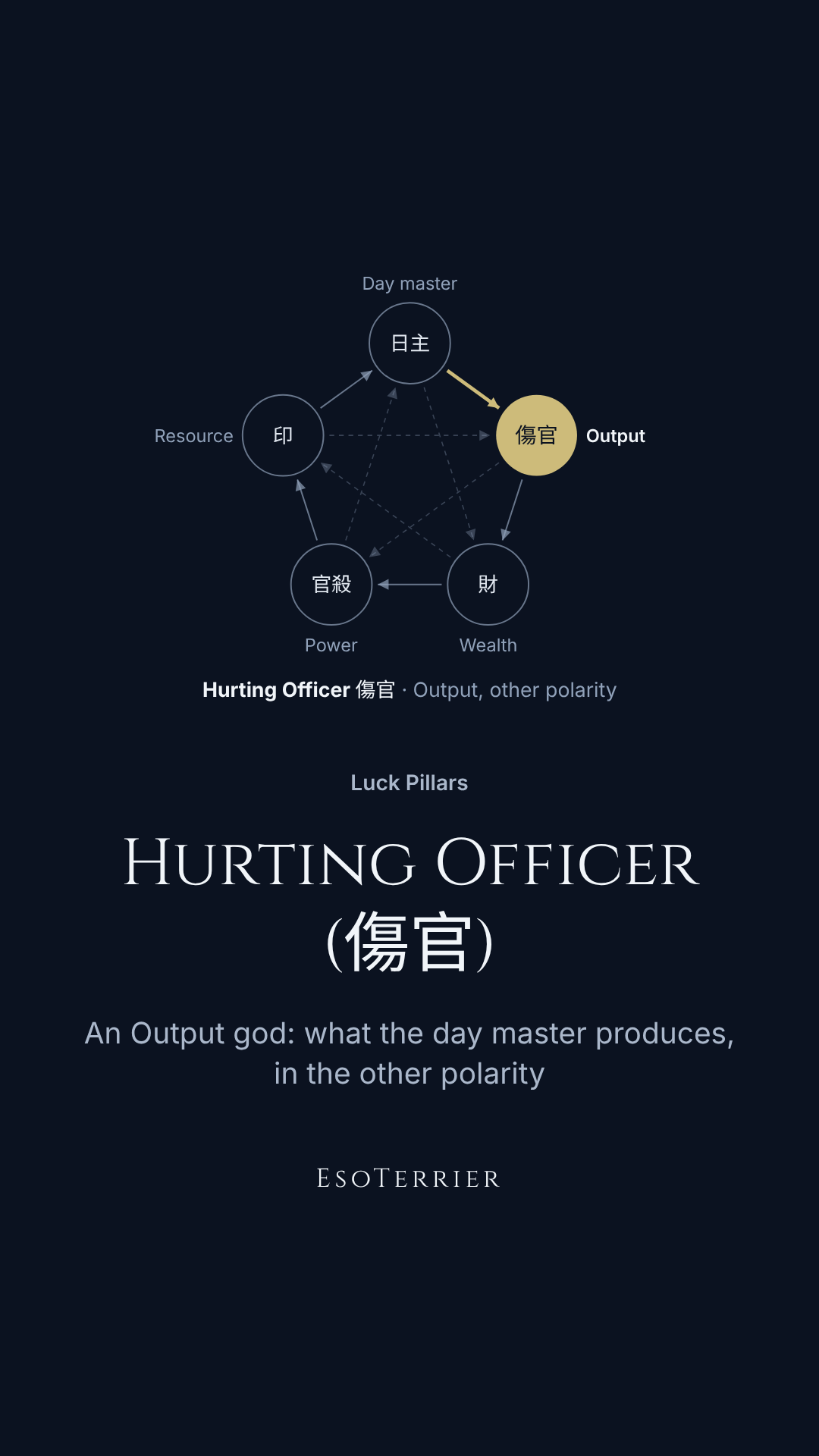
Meaning
傷官 is the stem the day master produces in the other polarity. Wood produces fire, so for a 甲 day master it is 丁, yin fire; for a 乙 day master 丙; for a 辛 day master, whose metal produces water, 壬.
Its name, like Rob Wealth's, is chart grammar. 丁 fire controls 辛 metal, and 辛 is 甲's Direct Officer, the stem of order and office. So the day master's own output "hurts the officer". Every Hurting Officer stands in that relation to the Direct Officer of the same chart, and the texts read it with the officer always in view.
No god gets stronger language in the old manuals. The 淵海子平 gives it two essays and the lines practitioners still quote: the hurting officer "proves itself like a god"; it should be "hurt to the end", spent completely rather than half-way; and a hurting officer that meets the officer "brings a hundred troubles". Its table gives it names of loss, 退財 and 耗氣, retreating wealth and draining qi.
The tradition did not agree with itself. When the 四庫 editors catalogued the 三命通會 in 1782, they faulted it for missing that the Hurting Officer "can also produce something remarkable". Modern English teaching has moved further that way, reading rebelliousness, talent and unconventionality; our chart's own one-line nature, labelled as ours, is "brilliance, rebellion, unconventional expression".
In a luck pillar
A Hurting Officer pillar has a stem the day master produces, in the other polarity. The tradition reads it as a decade when the day master's output turns against its officer, and so reads it with the natal Direct Officer in mind. The 淵海子平 lists luck in 丙, 丁, 巳 and 午 for a 甲 or 乙 day master under this god, and the 三命通會's rule is that the officer wants a luck that produces it, not one that hurts it (「官欲運生,不欲運傷」).
Those rules turn on what a chart has and needs: whether there is an officer to hurt, whether a seal restrains the output, whether the day master is strong. EsoTerrier computes neither strength nor the useful god, so our chart shows the pillar, its branch and hidden stems, and the relations it forms with the natal pillars, and makes no judgment of the decade. The texts' verdicts on disputes and on kin are not reproduced.
The Hurting Officer for each day master
The element produced, in the other polarity.
| Day master | Hurting Officer |
|---|---|
| 甲 Jiǎ (yang wood) | 丁 Dīng |
| 乙 Yǐ (yin wood) | 丙 Bǐng |
| 丙 Bǐng (yang fire) | 己 Jǐ |
| 丁 Dīng (yin fire) | 戊 Wù |
| 戊 Wù (yang earth) | 辛 Xīn |
| 己 Jǐ (yin earth) | 庚 Gēng |
| 庚 Gēng (yang metal) | 癸 Guǐ |
| 辛 Xīn (yin metal) | 壬 Rén |
| 壬 Rén (yang water) | 乙 Yǐ |
| 癸 Guǐ (yin water) | 甲 Jiǎ |
In the classical texts
The 滴天髓's verse on 辛 says it "delights in abundant water" (「樂水之盈」); 壬 is 辛's Hurting Officer, and the commentary says much 壬 makes 辛 excel (秀). Here the god is a gift, not a threat: the same relation, read by season and balance.
The 淵海子平's family table gives the Hurting Officer a man's granddaughter and grandmother and a woman's daughter. 任鐵樵 rejected the table's rules for the children and made both Output gods the children for everyone. Both are recorded as history, labelled disputed, and never applied to a family.
Correspondences
Each item with how it stands: “sourced” is in the work cited, “our construction” is EsoTerrier’s own, and “disputed” means the sources disagree.
- Classical names, 甲 day master
- 退財 and 耗氣, "retreating wealth" and "draining qi", in the 淵海子平's opening table sourced
- Classical names, 乙 day master
- 小人 and 盜氣, "the petty person" and "stolen qi", in the same table sourced
- Why "hurting the officer"
- For 甲, 丁 fire controls 辛 metal, and 辛 is 甲's Direct Officer sourced
- Family role in the 六親 table
- For a man the granddaughter and grandmother, for a woman the daughter; 任鐵樵 makes both Output gods the children. Recorded as history disputed
- In the stem verses
- The 滴天髓 on 辛: it delights in abundant water (「樂水之盈」); 壬 is 辛's Hurting Officer sourced
- Other English names
- Injured Officer, Indirect Output sourced
- Our one-line nature
- Brilliance, rebellion, unconventional expression our construction
How the schools read it
- *淵海子平* (Song material, Ming printing)
- Two essays and its most quoted lines: the hurting officer "proves itself like a god", must be "hurt to the end", and meeting the officer "brings a hundred troubles".
- *三命通會* (Ming)
- Explains the name by the control of the officer; its rule for decades is that the officer wants a luck that produces it, not one that hurts it.
- *四庫* editors (1782)
- Faulted the 三命通會 for not seeing that the Hurting Officer "can also produce something remarkable".
- Modern English teaching
- Rebelliousness, talent and unconventionality.
- EsoTerrier
- Our chart's line, a modern reading of our own: brilliance, rebellion, unconventional expression.
Claims about it
-
A Hurting Officer foretells quarrels, lawsuits and harm to relatives.
told as loreWhat the record shows: The texts' pronouncements in the idiom of their age, recorded as history and never applied to a person.
-
A Hurting Officer decade can be read in advance as a time of trouble.
unverifiedWhat the record shows: The tradition reads it against the natal officer and the whole chart.
-
The Hurting Officer is a fixed personality profile.
unverifiedWhat the record shows: A modern branded reading. In the texts it is a relation between two stems, read differently by different authors.