Meaning
The intuitive cycle is a 38-day wave that later versions of biorhythm tie to instinct and inner sense. It is not part of the theory as Fliess and Swoboda left it, nor of the three-cycle theory of the 1960s books. The earliest publication of it we have found is Mort Gale's Biorhythm Compatibility of 1978, seventy years after Swoboda and at the height of the craze.
That is why our chart keeps it apart. It is off by default; switched on, it is drawn and labelled as a 1978 addition, so that it is never mistaken for one of the older three. What later books say about it is their own reading, and there is no study of it at all; the tests of the 1970s and 1980s were aimed at the older three cycles.
The curve and its critical days
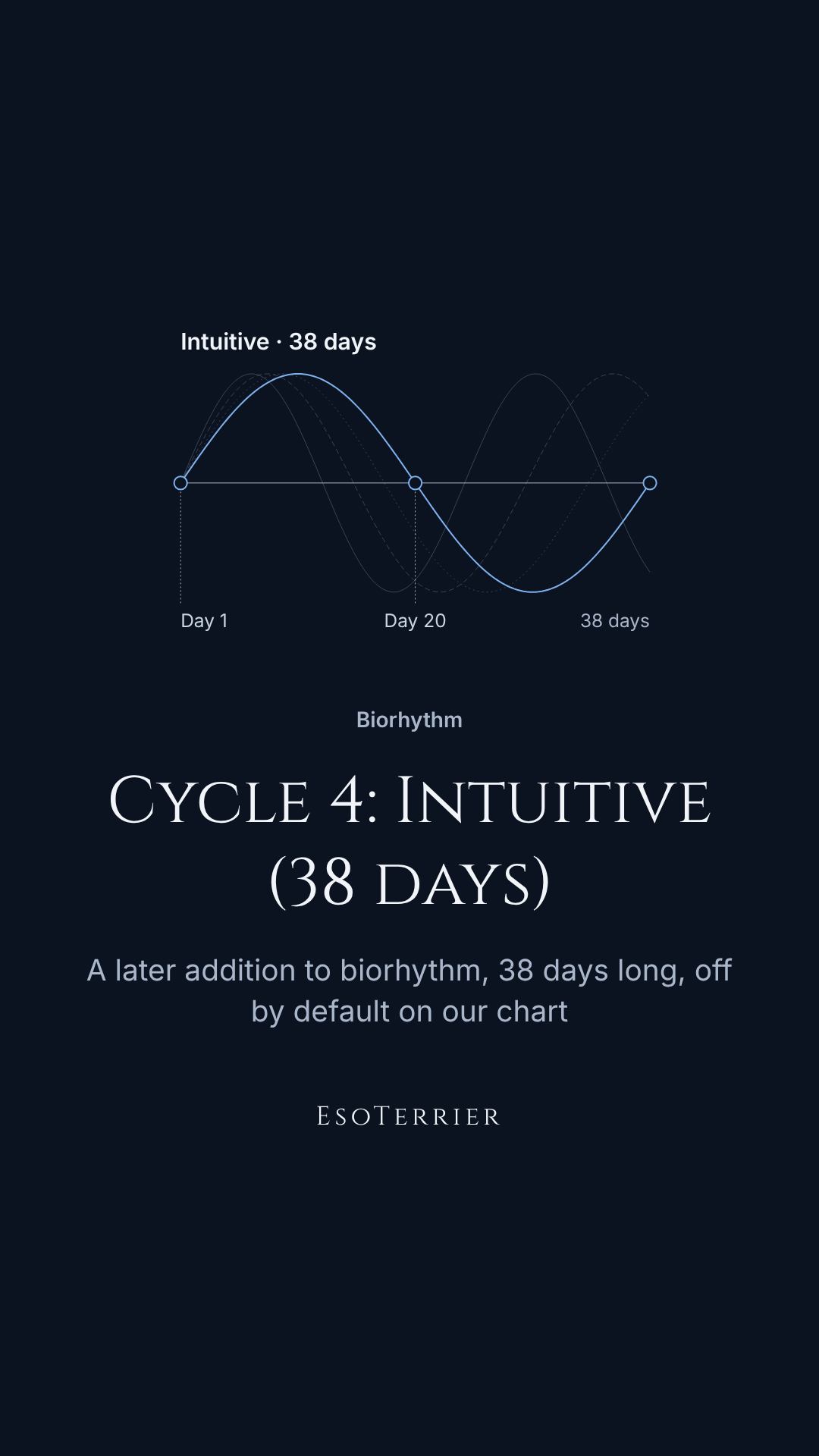
The intuitive curve starts on the midline on the day of birth, reaches its top during cycle day 10, crosses the midline exactly at the start of cycle day 20, reaches its bottom during cycle day 29 and returns to the midline as the next cycle begins. Its critical days are cycle days 1 and 20. Gale's own counting convention is not recorded in the sources we read, so these days follow our engine's rule for all four cycles: the day that contains a midline crossing.
With the intuitive cycle added, the whole pattern of four curves repeats only after 403,788 days, about 1,105 years; the three older cycles alone realign after 21,252 days, about 58.2 years. Figures of twice that length, which appear on some pages, are wrong.
Who added it
Gale's book is the first appearance we have found, from an annotated bibliography and a proponent's site; the book itself was not opened. Maurice F. Taylor's Biorhythm: 7 Cycles (1976) may have the cycle earlier, but its contents were not seen. Later books and apps went further and added 43-day "aesthetic", 48-day "awareness" and 53-day "spiritual" cycles, for which we found no source older than the craze. We show none of them.
Correspondences
Each item with how it stands: “sourced” is in the work cited, “our construction” is EsoTerrier’s own, and “disputed” means the sources disagree.
- Who introduced it
- Mort Gale, 1978, the earliest we have found; Maurice F. Taylor's seven-cycle book of 1976 may be earlier and was not seen disputed
- Relation to Fliess and Swoboda
- None: their work has periods of 23 and 28 days only sourced
- Critical days on our chart
- Cycle days 1 and 20, by the same crossing rule as the older cycles our construction
- Still further cycles
- 43-day aesthetic, 48-day awareness and 53-day spiritual cycles in later books and apps; not shown sourced
- Colour
- Violet in some later charts; a convention of the charts sourced
- Our wording
- A later version's curve, shown only on request so that it is never mistaken for one of the older three our construction
How the schools read it
- Fliess and Swoboda (1897 to 1909)
- No such cycle: their periods are 23 and 28 days.
- The books of the 1960s
- Three cycles only, in Wernli (1961) and Thommen (1964).
- Mort Gale (1978)
- A 38-day intuitive cycle beside the other three, in a book about comparing two people.
- Later books and apps
- Instinct and inner sense, and in some apps still more cycles of 43, 48 and 53 days.
- The critics (1978 to 1998)
- Their tests were aimed at the older three cycles; we know of no study of the intuitive cycle.
- EsoTerrier
- Shown on request and labelled as a 1978 addition, with its critical days on cycle days 1 and 20.
Claims about it
-
The four cycles realign only after more than two thousand years.
falseWhat the record shows: The least common multiple of 23, 28, 33 and 38 is 403,788 days, about 1,105 years.
-
The intuitive cycle tells you when to trust your hunches.
falseWhat the record shows: No study of this cycle exists, and the tests of the older three, summed up in a 1998 review of 134 studies, did not bear them out.